UNITED STATES
SECURITIES AND EXCHANGE COMMISSION
Washington, D.C. 20549
SCHEDULE 14A
(RULE 14a-101)
SCHEDULE 14A INFORMATION
Proxy Statement Pursuant to Section 14(a) of the
Securities Exchange Act of 1934
Filed by the Registrant ☒
Filed by a Party other than the Registrant ☐
Check the appropriate box:
| ☒ | Preliminary Proxy Statement | ||||
| ☐ | Confidential, for Use of the Commission Only (as permitted by Rule 14a-6(e)(2)) | ||||
| ☐ | Definitive Proxy Statement | ||||
| ☐ | Definitive Additional Materials | ||||
| ☐ | Soliciting Material Pursuant to §240.14a-12 | ||||
| NN, INC. | ||
| (Name of Registrant as Specified In Its Charter) | ||
| (Name of Person(s) Filing Proxy Statement, if other than the Registrant) | ||
Payment of Filing Fee (Check the appropriate box):
| ☒ | No fee required. | ||||
| ☐ | Fee paid previously with preliminary materials. | ||||
| ☐ | Fee computed on table in exhibit required by Item 25(b) per Exchange Act Rules 14a-6(i)(1) and 0-11 | ||||
PRELIMINARY PROXY STATEMENT – SUBJECT TO COMPLETION

NN, INC.
6210 Ardrey Kell Road, Suite 120
Charlotte, North Carolina 28277
NOTICE OF SPECIAL MEETING OF STOCKHOLDERS
Dear Stockholder:
You are cordially invited to attend a special meeting of the stockholders (the “Special Meeting”) of NN, Inc., a Delaware corporation. The Special Meeting will be held on ________ __, 2026 at 12:00 p.m. Eastern Time at Courtyard by Marriott Charlotte Waverly, 6319 Providence Farm Lane, Charlotte, North Carolina 28277.
You are being asked to vote on the following matters:
(1)To approve an Amended and Restated Certificate of Incorporation to increase the authorized number of shares of common stock from 90,000,000 shares to 180,000,000 shares.
(2)To approve an Amended and Restated Certificate of Incorporation to provide for exculpation of officers permitted by Delaware law.
(3)To approve an Amended and Restated Certificate of Incorporation to add forum selection provisions.
(4)To approve an Amended and Restated Certificate of Incorporation to clarify voting requirements to amend the number of shares of authorized common stock and preferred stock.
(5)To approve an Amended and Restated Certificate of Incorporation to clarify requirements to amend any certificate of designation that relates to the terms of one or more outstanding series of preferred stock.
(6)To approve an Amended and Restated Certificate of Incorporation to remove outdated provisions related to the declassification of our board of directors and make other ministerial changes.
(7)To conduct any other business properly brought before the Special Meeting and any adjournment or postponement thereof.
These items of business are more fully described in the Proxy Statement accompanying this Notice.
The record date for the Special Meeting is August 4, 2026. Only stockholders of record as of the close of business on that date may vote at the Special Meeting or any adjournment or postponement thereof. A complete list of record stockholders will be available for examination by any stockholder for any purpose germane to the Special Meeting for a period of ten days ending on the day before the Special Meeting date. If you would like to view the list, please send an email to investor relations.
| By Order of the Board of Directors, | |||||
| /s/ | |||||
| Harold C. Bevis | |||||
| President, Chief Executive Officer and Director | |||||
Charlotte, North Carolina ________ __, 2026 | |||||
This proxy statement and accompanying form of proxy card are first being made available to stockholders on or about ________ __, 2026.
You are cordially invited to attend the Special Meeting in person. Whether or not you expect to attend the Special Meeting, please complete, date, sign and return the enclosed proxy card, or vote over the telephone or the internet as instructed in these materials, as promptly as possible in order to ensure your representation at the Special Meeting. Even if you have voted by proxy, you may still vote in person if you attend the Special Meeting. Please note, however, that if your shares are held of record by a broker, bank or other agent and you wish to vote at the Special Meeting, you must obtain a proxy issued in your name from that record holder.
TABLE OF CONTENTS
| Page # | |||||
Website References
You may also access additional information about NN, Inc. at https://investors.nninc.com. References to our websites throughout this proxy statement are provided for convenience only and the content on our website does not constitute a part of this proxy statement.
NN, INC.
6210 Ardrey Kell Road, Suite 120
Charlotte, North Carolina 28277
PROXY STATEMENT FOR THE
SPECIAL MEETING OF STOCKHOLDERS
TO BE HELD ON ________ __, 2026
QUESTIONS AND ANSWERS ABOUT THE SPECIAL MEETING
Why am I receiving these materials?
We have sent you this proxy statement and the Proxy Card (collectively, the “Proxy Materials”) because the Board of Directors (the “Board”) of NN, Inc. (the “Company” or “NN”) is soliciting your proxy to vote at the special meeting of stockholders (the “Special Meeting”), including any adjournment or postponement thereof. This proxy statement summarizes the information you will need to know to cast an informed vote at the Special Meeting. You are invited to attend the Special Meeting to vote on the proposals as described in this proxy statement. However, you do not need to attend the Special Meeting to vote your shares. Instead, you may simply complete, sign and return the enclosed Proxy Card, or follow the instructions below to submit your proxy over the telephone or through the internet.
We intend to mail the Proxy Materials on or about ________ __, 2026 to all stockholders of record entitled to vote at the Special Meeting.
How do I attend the Special Meeting?
The Special Meeting will be held on ________ __, 2026, at 12:00 p.m. Eastern Time, at Courtyard by Marriott Charlotte Waverly, 6319 Providence Farm Lane, Charlotte, North Carolina 28277. Information on how to vote in person at the Special Meeting is discussed below. You are entitled to attend the Special Meeting if you were a stockholder of record as of the close of business on August 4, 2026, the record date for the Special Meeting (the “Record Date”), or hold a valid proxy for the Special Meeting.
If you are a stockholder of record, your name will be verified against the list of stockholders of record prior to your admittance to the Special Meeting or any adjournment or postponement thereof. You should be prepared to present photo identification for admission. If you are a beneficial owner of shares registered in the name of your bank, broker, or other agent, you will need to provide proof of beneficial ownership on the Record Date, such as a brokerage account statement showing that you owned stock as of the Record Date, a copy of a voting instruction form provided by your bank, broker, or other agent, or other similar evidence of ownership as of the Record Date, as well as your photo identification, for admission. If you do not provide the necessary identification, you will not be admitted to the Special Meeting or any adjournment or postponement thereof. For security reasons, you and your bags may be subject to search prior to your admittance to the Special Meeting.
Who can vote at the Special Meeting?
Only stockholders of record at the close of business on the Record Date will be entitled to vote at the Special Meeting. On the Record Date, there were 77,080,864 shares of common stock outstanding and entitled to vote.
Stockholder of Record: Shares Registered in Your Name
If on the Record Date your shares of common stock were registered directly in your name with our transfer agent, then you are a stockholder of record. As a stockholder of record, you may attend and vote at the Special Meeting or you may vote before the Special Meeting by proxy through the internet, by telephone or by using the enclosed proxy card. Whether or not you plan to attend the Special Meeting, we urge you to fill out and return the enclosed Proxy Card or vote by proxy over the telephone or on the internet as instructed below to ensure your vote is counted.
Beneficial Owner: Shares Registered in the Name of a Broker, Bank or Other Agent
If on the Record Date your shares of common stock were held not in your name, but rather in an account at a broker, bank or other agent, then you are the beneficial owner of shares held in “street name,” and these proxy materials are being forwarded to you by that organization. The organization holding your account is considered to be the stockholder of record for purposes of voting at the Special Meeting. As a beneficial owner, you have the right to direct your broker, bank or other agent regarding how to vote the shares in your account.
You are also invited to attend the Special Meeting. However, since you are not the stockholder of record, you may not vote during the Special Meeting unless you request and obtain a valid proxy from your broker, bank or other agent, as required. You must follow the instructions provided by your broker, bank or other agent to vote your shares per your instructions.
Will I be able to ask questions at the Special Meeting?
We plan to spend up to 15 minutes answering questions that are relevant to the proposals to be voted on at the Special Meeting and will include as many stockholder questions that comply with the rules of conduct for the Special Meeting as the allotted time permits. If we receive substantially similar questions, we will group such questions together and provide a single response to avoid repetition.
What am I voting on?
There are six matters scheduled for a vote at the Special Meeting:
•Proposal No. 1: To approve an Amended and Restated Certificate of Incorporation to increase the authorized number of shares of common stock from 90,000,000 shares to 180,000,000 shares.
•Proposal No. 2: To approve an Amended and Restated Certificate of Incorporation to provide for exculpation of officers permitted by Delaware law.
•Proposal No. 3: To approve an Amended and Restated Certificate of Incorporation to add forum selection provisions.
•Proposal No. 4: To approve an Amended and Restated Certificate of Incorporation to clarify voting requirements to amend the number of shares of authorized common stock and preferred stock.
•Proposal No. 5: To approve an Amended and Restated Certificate of Incorporation to clarify requirements to amend any certificate of designation that relates to the terms of one or more outstanding series of preferred stock.
•Proposal No. 6: To approve an Amended and Restated Certificate of Incorporation to remove outdated provisions related to the declassification of our board of directors and make other ministerial changes.
How does the Board recommend that I vote?
The Board recommends that you vote “For” each of the proposals.
What if another matter is properly brought before the meeting?
The Board knows of no other matters that will be presented for consideration at the Special Meeting. If any other matters are properly brought before the meeting, it is the intention of the persons named in the accompanying proxy card to vote on those matters in accordance with their best judgment.
How do I vote?
For each of the proposals, you may vote “For” or “Against” or abstain from voting.
Please note that by casting your vote by proxy you are authorizing the individuals listed on the Proxy Card to vote your shares in accordance with your instructions and in their discretion with respect to any other matter that properly comes before the Special Meeting or any adjournments or postponements thereof.
The procedures for voting are fairly simple:
Stockholder of Record: Shares Registered in Your Name
If you are a stockholder of record as of the Record Date, you may vote in person during the Special Meeting or you may vote by proxy using the enclosed Proxy Card, over the telephone or through the internet.
Whether or not you plan to attend the Special Meeting, we urge you to vote by proxy to ensure your vote is counted. You may still attend the meeting and vote in person even if you have already voted by proxy.
•To vote in person, come to the Special Meeting and we will give you a ballot when you arrive.
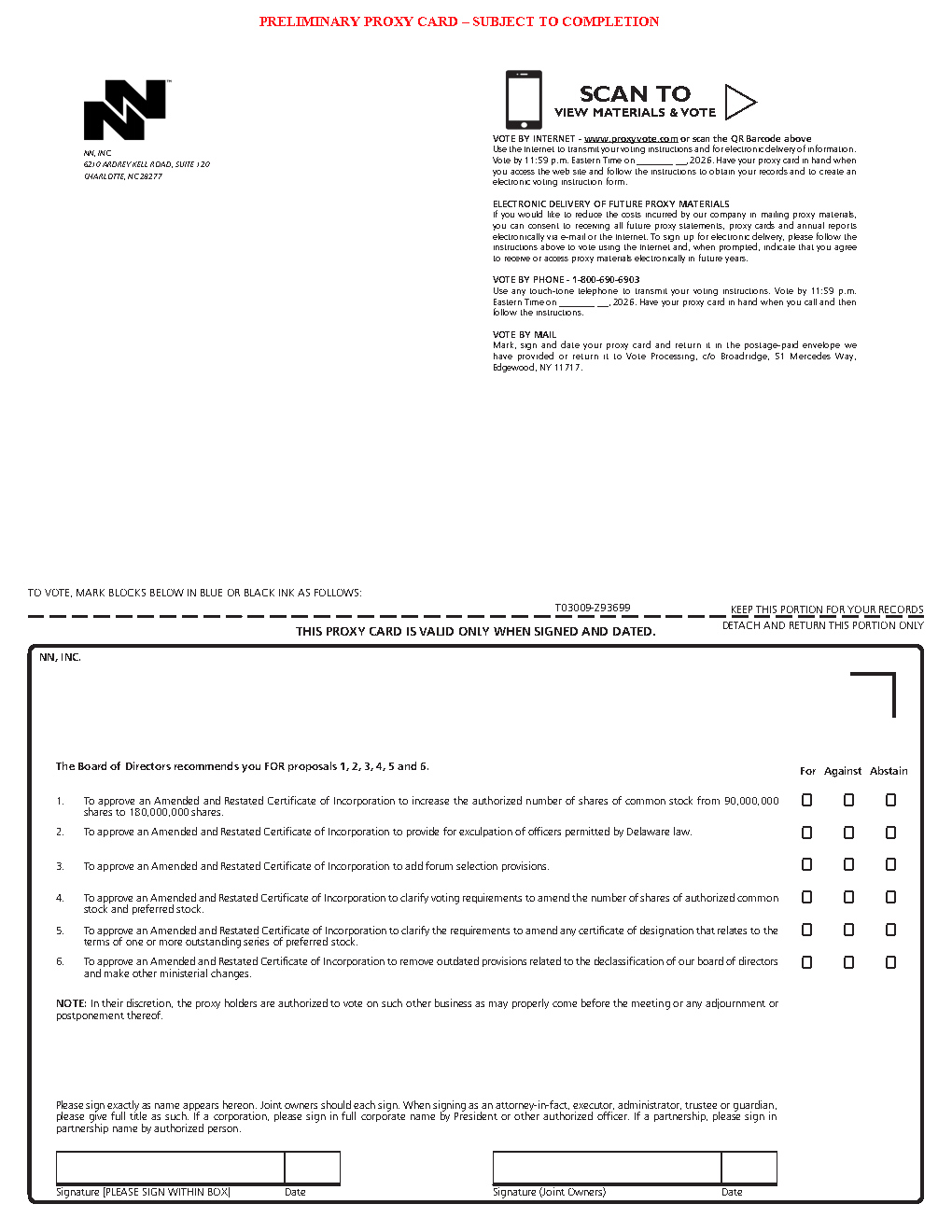
•To vote using the Proxy Card, simply complete, sign and date the enclosed Proxy Card and return it promptly in the envelope provided. If you return your signed Proxy Card to us before the Special Meeting, we will vote your shares as you direct.
•To vote over the telephone, dial toll-free 1-800-690-6903 using a touch-tone phone and follow the recorded instructions. You will be asked to provide the company number and control number from the enclosed Proxy Card. Your telephone vote must be received by 11:59 p.m., Eastern Time on ________ __, 2026 to be counted.
•To vote through the internet, go to www.proxyvote.com to complete an electronic Proxy Card. You will be asked to provide the company number and control number from the enclosed Proxy Card. Your internet vote must be received by 11:59 p.m., Eastern Time on ________ __, 2026 to be counted.
Beneficial Owner: Shares Registered in the Name of Broker, Bank or Other Agent
If you are a beneficial owner of shares registered in the name of your broker, bank or other agent, you should have received these Proxy Materials from that organization rather than from NN, Inc. Simply complete and mail the voting instruction form to ensure your vote is counted. Alternatively, you may vote by telephone or over the internet as instructed by your bank or broker. To vote at the Special Meeting, you must obtain a valid proxy from your broker, bank or other agent. Follow the instructions from your broker, bank or other agent included with these Proxy Materials or contact your broker, bank or other agent to request a proxy form.
| Internet proxy voting may be provided to allow you to vote your shares online, with procedures designed to ensure the authenticity and correctness of your proxy vote instructions. However, please be aware that you must bear any costs associated with your internet access, such as usage charges from internet access providers and telephone companies. | ||
How many votes do I have?
On each matter to be voted upon, you have one vote for each share of common stock you own as of the close of business on the Record Date.
What happens if I do not vote?
Stockholder of Record: Shares Registered in Your Name
If you are a stockholder of record and do not vote by completing your Proxy Card, by telephone, through the internet or in person at the Special Meeting, your shares will not be voted.
Beneficial Owner: Shares Registered in the Name of Broker, Bank or Other Agent (Broker non-votes)
If you are a beneficial owner and do not instruct your broker, bank, or other agent how to vote your shares, the question of whether your broker, bank or other agent will still be able to vote your shares depends on whether the New York Stock Exchange (“NYSE”) deems the particular proposal to be a “routine” matter. Brokers, banks and other agents can use their discretion to vote “uninstructed” shares with respect to matters that are considered to be “routine,” but not with respect to “non-routine” matters. A “broker non-vote” occurs when your broker, bank or other agent submits a proxy with respect to “routine” matters but does not vote on “non-routine” matters because you did not provide voting instructions on those matters. These unvoted shares with respect to “non-routine” matters are counted as “broker non-votes.” Under the rules and interpretations of the NYSE, “non-routine” matters are matters that may substantially affect the rights or privileges of stockholders. Proposals No. 2, 3, 4, and 5 are each considered to be a “non-routine” matter and, accordingly, your broker, bank or other agent may not vote your shares on such proposals without your instructions. Proposals No. 1 and 6 are each considered to be a “routine” matter and, accordingly, your broker, bank or other agent may vote your shares even in the absence of your instruction.
What if I return a Proxy Card or otherwise vote but do not make specific choices?
If you return a signed and dated Proxy Card or otherwise vote without marking voting selections on matters on which you are entitled to cast votes, your shares will be voted “For” each of the proposals. If any other matter is properly presented at the Special Meeting, your proxyholder (one of the individuals named on your Proxy Card) will vote your shares using his best judgment.
Who is paying for this proxy solicitation?
The accompanying proxy is being solicited by the Board. We have engaged Broadridge as a proxy solicitor to assist the Board in the solicitation of proxies for the Special Meeting. We expect to pay Broadridge a fee of $26,943 plus reasonable expenses and customary charges for these services, which include the payment of certain fees and expenses for its services to solicit proxies. We will pay for the entire cost of soliciting proxies. In addition to these Proxy Materials, our directors and employees may also solicit
proxies in person, by telephone, or by other means of communication. Directors and employees will not be paid any additional compensation for soliciting proxies. We may also reimburse brokers, banks and other agents for the cost of forwarding Proxy Materials to beneficial owners.
What does it mean if I receive more than one set of Proxy Materials?
If you receive more than one set of Proxy Materials, your shares may be registered in more than one name or in different accounts. Please follow the voting instructions on the Proxy Cards in the Proxy Materials to ensure that all of your shares are voted.
Can I change my vote after submitting my proxy?
Stockholder of Record: Shares Registered in Your Name
Yes. You can revoke your proxy at any time before the final vote at the Special Meeting. If you are the record holder of your shares, you may revoke your proxy in any one of the following ways:
•You may submit another properly completed Proxy Card with a later date.
•You may grant a subsequent proxy by telephone or through the internet.
•You may send a timely written notice that you are revoking your proxy to NN, Inc., 6210 Ardrey Kell Road, Suite 120, Charlotte, North Carolina 28277, Attention: Secretary.
•You may attend the Special Meeting and vote in person. Simply attending the Special Meeting will not, by itself, revoke your proxy.
Your most current Proxy Card or telephone or internet proxy is the one that is counted.
Beneficial Owner: Shares Registered in the Name of Broker, Bank or Other Agent
If your shares are held by your broker, bank or other agent, you should follow the instructions provided by your broker, bank or other agent.
When are stockholder proposals and director nominations due for next year’s annual stockholder meeting?
To be considered for inclusion in next year’s annual stockholder meeting proxy materials, your proposal must be received by us at our executive offices not later than December 7, 2026. If you wish to submit a proposal (including a director nomination) at the meeting that is not to be included in next year’s proxy materials, such proposal must be received by us in writing not later than the close of business on February 19, 2027 nor earlier than the close of business on January 20, 2027 to be considered. You are also advised to review our Bylaws, which contain a description of the information required to be submitted, as well as additional requirements about advance notice of stockholder proposals and director nominations.
How are votes counted?
Votes will be counted by the inspector of election appointed for the Special Meeting, who will separately count votes “For” and “Against,” abstentions and, if applicable, broker non-votes.
How many votes are needed to approve each proposal?
The following table summarizes the minimum vote needed to approve each proposal and the effect of abstentions and broker non-votes.
Proposal Number | Proposal Description | Vote Required for Approval | Effect of Abstentions | Effect of Broker Non-Votes | |||||||||||||||||||||||||
| 1 | Approval of Amended and Restated Certificate of Incorporation to increase the authorized number of shares of common stock from 90,000,000 shares to 180,000,000 shares | “For” votes from the majority of votes cast | No Effect | No broker non-votes; brokers have discretion to vote | |||||||||||||||||||||||||
| 2 | Approval of Amended and Restated Certificate of Incorporation to provide for exculpation of officers permitted by Delaware law | “For” votes from the majority in voting power of the shares of stock entitled to vote thereon | Abstentions will have the effect of an AGAINST vote | Broker non-votes have the effect of a vote AGAINST | |||||||||||||||||||||||||
| 3 | Approval of Amended and Restated Certificate of Incorporation to add forum selection provisions | “For” votes from the majority in voting power of the shares of stock entitled to vote thereon | Abstentions will have the effect of an AGAINST vote | Broker non-votes will have the effect of a vote AGAINST | |||||||||||||||||||||||||
| 4 | Approval of Amended and Restated Certificate of Incorporation to clarify voting requirements to amend the number of shares of authorized common stock and preferred stock | “For” votes from the majority in voting power of the shares of stock entitled to vote thereon | Abstentions will have the effect of an AGAINST vote | Broker non-votes will have the effect of a vote AGAINST | |||||||||||||||||||||||||
| 5 | Approval of Amended and Restated Certificate of Incorporation to clarify requirements to amend any certificate of designation that relates to the terms of one or more outstanding series of preferred stock | “For” votes from the majority in voting power of the shares of stock entitled to vote thereon | Abstentions will have the effect of an AGAINST vote | Broker non-votes will have the effect of a vote AGAINST | |||||||||||||||||||||||||
| 6 | Approval of Amended and Restated Certificate of Incorporation to remove outdated provisions related to the declassification of our board of directors and make other ministerial changes | “For” votes from the holders of at least 66 2/3% of the voting power of our outstanding common stock | Abstentions will have the effect of an AGAINST vote | No broker non-votes; brokers have discretion to vote | |||||||||||||||||||||||||
What is the quorum requirement?
A quorum of stockholders is necessary to hold a valid meeting. A quorum will be present if a majority of the shares of common stock entitled to vote at the Special Meeting are present in person or represented by proxy. On the Record Date, there were 77,080,864 shares of common stock outstanding and entitled to vote. Thus, shares representing 38,540,433 votes must be present in person or represented by proxy at the Special Meeting to have a quorum.
Your shares will be counted towards the quorum only if you submit a valid proxy (or one is submitted on your behalf by your broker, bank or other agent) or if you vote in person at the Special Meeting. Abstentions and broker non-votes will be counted towards the quorum requirement. If there is no quorum, the chairman of the meeting may adjourn the meeting to another date.
How can I find out the results of the voting at the Special Meeting?
Preliminary voting results will be announced at the Special Meeting. In addition, final voting results will be published in a current report on Form 8-K that we expect to file within four business days after the Special Meeting. If final voting results are not available to us in time to file a Form 8-K within four business days after the Special Meeting, we intend to file a Form 8-K to publish preliminary results and, within four business days after the final results are known to us, file an additional Form 8-K to publish the final results.
What proxy materials are available on the internet?
This proxy statement and the Proxy Card will be available at https://www.proxyvote.com.
PROPOSAL NO. 1 – APPROVAL OF AN AMENDED AND RESTATED CERTIFICATE OF INCORPORATION TO INCREASE THE AUTHORIZED NUMBER OF SHARES OF COMMON STOCK FROM 90,000,000 SHARES TO 180,000,000 SHARES
At the Special Meeting, stockholders will be asked to consider and approve an amendment and restatement of our Certificate of Incorporation to increase the authorized number of shares of our common stock from 90,000,000 shares to 180,000,000 shares. The Board has declared the proposed amendments to our Certificate of Incorporation (the “Current Certificate”) set forth in this proposal and in Appendix A to this proxy statement advisable and determined them to be in the best interests of the Company and our stockholders for the reasons discussed below.
Reasons for the Proposed Increase in Authorized Shares
As of August 5, 2026, we had 90,000,000 authorized shares of common stock of which 82,580,864 shares were issued and outstanding. Of the remaining 7,419,136 authorized shares of common stock, 2,236,556 shares are reserved for future issuance upon the exercise of issued and outstanding equity awards under our Amended and Restated 2022 Omnibus Incentive Plan (the “2022 Plan”), 4,258,400 shares are reserved for future issuance upon exercise of issued and outstanding inducement equity awards (outside of the 2022 Plan), 15,300 shares are reserved for future issuance upon the exercise of issued and outstanding equity awards under our 2019 Omnibus Incentive Plan, 43,600 shares are reserved for future issuance upon the exercise of issued and outstanding equity awards under our 2016 Omnibus Incentive Plan, 89,305 shares are reserved for future issuance under our 2022 Plan, and 405,828 shares are reserved for future issuance upon exercise of outstanding warrants. This leaves only 370,147 shares of our authorized common stock unreserved and available for future issuance.
The Board believes it is in the best interests of the Company and our stockholders to increase the number of authorized shares of our common stock to give us greater flexibility in considering and planning for future potential business needs, including public offerings or private placements of our common stock for capital raising purposes, including transactions intended to reduce our operating leverage, and issuances of our common stock in connection with acquisitions or other strategic transactions. We do not currently have any definitive agreements or arrangements to issue any of the proposed additional authorized shares of common stock that will become available for issuance if this proposal is approved and the proposed amendments to the Current Certificate are effected. Additionally, at the Company’s 2026 Annual Meeting of Stockholders, our stockholders approved the 2022 Plan which, among other things, increased the number of shares of our common stock reserved for issuance thereunder by 2,000,000 shares. However, we do not currently have a sufficient number of available authorized shares to grant equity compensation awards to employees and other eligible individuals at the levels the Board believes may be necessary to properly incentivize, attract and retain new and current employees and other eligible individuals. Having the additional authorized shares available will also help to provide appropriate equity incentives to assist in the recruitment and retention of employees and other eligible individuals.
Rights of Additional Authorized Shares
The proposed amendments to the Current Certificate would not have any effect on the par value per share of our common stock. Our common stock is all of a single class, with equal voting, distribution, liquidation and other rights. The additional common stock to be authorized by the proposed amendments, if approved and implemented, would have rights identical to our currently outstanding common stock. Should the Board issue additional shares of common stock, existing stockholders would not have any preferential rights to purchase any newly authorized shares of common stock solely by virtue of their ownership of shares of our common stock, and their percentage ownership of our then outstanding common stock could be reduced.
Potential Adverse Effects
We have not proposed the increase in the number of authorized shares of common stock with the purpose or intention of using the additional authorized shares for anti-takeover purposes, such as to oppose a hostile takeover attempt or to delay or prevent a change in control of the Company that the Board does not support, but we could use the additional shares for such purpose. The proposed amendments, if approved and implemented, will increase the number of authorized but unissued shares of our common stock, and, subject to compliance with law and the listing rules of the Nasdaq Stock Market, the Board could issue, without further stockholder approval, the additional shares available as a result of such increase in one or more transactions that could make it more difficult for a party to effect a takeover or change in control of the Company that the Board does not support. For example, the Board could issue additional shares without further stockholder approval (subject to compliance with law and the listing rules of the Nasdaq Stock Market) so as to dilute the stock ownership or voting rights of persons seeking to obtain control of the Board or of the Company in a transaction that the Board does not support, including in a transaction in which a person is offering a premium to our stockholders for their shares of our common stock over then current market prices. The proposed increase in authorized shares of our common stock has been prompted by business and financial considerations described above under “Reasons for the Proposed Increase in Authorized Shares” and not by the threat of any known or threatened hostile takeover attempt. However, stockholders should be aware that by potentially discouraging initiation of any such unsolicited takeover attempts, the proposed amendments may limit the opportunity for our stockholders to receive a premium for their shares over then current market prices generally available in such takeover attempts.
Additionally, the issuance of additional shares of common stock could have the effect of diluting existing stockholders earnings per share, book value per share and voting power.
Risks of Not Approving This Proposal
If stockholders do not approve this proposal, we will continue to have 90,000,000 authorized shares of common stock, of which 370,147 shares are not outstanding or not reserved for future issuance as of August 5, 2026. This could adversely impact our ability to pursue opportunities in which shares of our common stock could be issued that the Board may determine would otherwise be in the best interests of the Company and our stockholders, including financing and strategic transaction opportunities and employee recruitment and retention purposes, as described above under “Reasons for the Proposed Increase in Authorized Shares”.
Proposed Amendment
We are proposing to amend and restate the first sentence of SECTION 1 of ARTICLE IV of the Current Certificate to read in its entirety as follows:
“SECTION 1. The total number of shares of capital stock that the Corporation shall have the authority to issue is 185,000,000 shares, consisting of 180,000,000 shares of common stock, par value $0.01 per share (“Common Stock”), and 5,000,000 shares of preferred stock, par value $0.01 per share (“Preferred Stock”)
In Appendix A, text proposed to be added to the Current Certificate is underlined and text proposed to be deleted from the Current Certificate is struck through.
Effect of Stockholder Approval of this Proposal
Approval of this Proposal 1 constitutes approval of the proposed amendment and restatement of SECTION 1 of ARTICLE IV of the Current Certificate as set forth above and in Appendix A.
Stockholders are also being asked to consider Proposals 2, 3, 4, 5 and 6 in this proxy statement, which relate to additional amendments to the Current Certificate. The form of the Amended and Restated Certificate of Incorporation that would be adopted if our stockholders approve each of Proposals 2, 3, 4, 5 and 6 is set forth in Appendix A. However, none of Proposals 1, 2, 3, 4, 5 and 6 is conditioned on or requires the approval of any other proposal. If this Proposal 1 is approved by our stockholders, the Current Certificate would be amended and restated to effect the changes proposed pursuant to this Proposal 1 even if our shareholders do not approve Proposals 2, 3, 4, 5 and/or 6. Any proposed amendment to the Current Certificate that is approved by our stockholders will become effective upon our filing with the Secretary of State of the State of Delaware of the version of the Amended and Restated Certificate of Incorporation that includes only that approved amendment, which we expect to do as soon as practicable following the Special Meeting.
THE BOARD OF DIRECTORS RECOMMENDS
A VOTE “FOR” PROPOSAL NO. 1.
PROPOSAL NO. 2 – APPROVAL OF AN AMENDED AND RESTATED CERTIFICATE OF INCORPORATION TO PROVIDE FOR EXCULPATION OF OFFICERS PERMITTED BY DELAWARE LAW
At the Special Meeting, stockholders will be asked to consider and approve an amendment and restatement of the Current Certificate to limit the liability of officers of the Company as permitted by the General Corporation Law of the State of Delaware (the “DGCL”). ARTICLE VIII of the Current Certificate eliminates or limits the personal liability of directors of the Company for monetary damages for breach of fiduciary duty as a director pursuant to, and consistent with, the DGCL. This is referred to as “exculpation.” Effective August 1, 2022, Section 102(b)(7) of the DGCL was amended to permit a corporation to extend exculpation to certain officers of the corporation in certain circumstances. To extend the protections of amended Section 102(b)(7) of the DGCL to its officers, a Delaware corporation must affirmatively amend its certificate of incorporation to include such a provision, as the protections do not apply automatically.
In light of the amendments to the DGCL and for the reasons discussed below, the Board has declared the proposed amendments to the Current Certificate set forth in this proposal and in Appendix A to this proxy statement advisable and determined them to be in the best interests of the Company and our stockholders. The DGCL only permits and, accordingly, the amendments to ARTICLE VIII of the Current Certificate proposed by this proposal would only permit exculpation of officers for direct claims brought by stockholders for breach of an officer’s fiduciary duty of care, including class actions, and would not eliminate or limit any officer’s liability for (i) any breach of the officer’s duty of loyalty to the Company or its stockholders, (ii) acts or omissions not in good faith or which involve intentional misconduct or a knowing violation of law, (iii) any transaction from which the officer derived an improper personal benefit, or (iv) claims brought by or in the right of the Company, such as derivative claims brought by stockholders.
General Effect of the Proposed Officer Exculpation Amendments
The proposed amendments to ARTICLE VIII of the Current Certificate would protect certain officers of the Company against personal liability to our stockholders for monetary damages for breach of the duty of care in certain actions as permitted by Section 102(b)(7) of the DGCL. The proposed amendments to ARTICLE VIII of the Current Certificate would not, however, eliminate any of our officers’ fiduciary duties, including their duty of care. In other words, our officers would remain obligated to exercise appropriate diligence, act in good faith, and otherwise comply with the standards of Delaware law in carrying out their duties. Accordingly, the proposed amendments would have no effect on the availability of equitable remedies such as an injunction or rescission based on an officer’s breach of fiduciary duty. Additionally, as indicated above, our officers would remain liable for breaches of the duty of care brought by or in the right of the Company. Accordingly, the proposed amendments would not prevent the Company itself from pursuing claims against officers, nor would it prevent stockholders from bringing derivative claims alleging breach of duty of care. Further, and also as indicated above, the proposed amendments would not limit or eliminate the liability of officers for any breach of their duty of loyalty to the Company or our stockholders, any act or omission not in good faith or involving intentional misconduct or a knowing violation of law, or any transaction from which an officer derived an improper personal benefit. The exculpation that would be afforded to officers of the Company if this proposal is approved would not be retroactive to any act or omission occurring prior to the effective date of the proposed Amended and Restated Certificate of Incorporation.
The proposed amendments to ARTICLE VIII of the Current Certificate would also (a) permit our officers to receive the benefit of any future amendments to the DGCL that further limit or eliminate the liability of officers without further amendment or modification of our certificate of incorporation, and (b) provide that any future amendment, modification or repeal of any provision of the proposed ARTICLE VIII, would be prospective only and would not adversely affect any limitation on the liability of an officer existing at the time of any such amendment, modification or repeal of such inconsistent provision. This is consistent with the existing provisions of ARTICLE VIII of the Current Certificate as they relate to director exculpation as permitted by the DGCL and is intended to increase the flexibility of the Current Certificate to allow it to change automatically with changes in the DGCL over time.
Reasons for the Proposed Officer Exculpation Amendments
The Board believes that officer exculpation under the circumstances permitted by the DGCL and reflected in the proposed amendments to ARTICLE VIII of the Current Certificate is reasonable and appropriate. The DGCL has long provided that a Delaware corporation’s certificate of incorporation could exculpate directors from certain liabilities and ARTICLE VIII of the Current Certificate includes such exculpatory provisions. Until the changes to Section 102(b)(7) of the DGCL were enacted, Delaware corporations were not able to provide similar protection to officers. Officers, like directors, are exposed to a substantial risk of lawsuits seeking to impose personal monetary liability. Frequently, directors and officers must make decisions in response to time-sensitive opportunities and challenges, which can create substantial risk of investigations, claims, actions, suits, or proceedings seeking to impose liability on the basis of hindsight. As with director exculpation, officer exculpation is intended to enable officers to exercise their business judgment in furtherance of stockholder interests by limiting their concerns about exposure to personal liability. Officer exculpation provisions are also intended to minimize frivolous lawsuits that name officers as defendants when directors cannot be named because of their exculpatory protection as a litigation strategy to compel settlement offers. The costs of such lawsuits may be borne by the Company directly through agreements providing for indemnification of officers and/or indirectly through higher insurance premiums. Notably, the exculpation that would be afforded to officers of the Company if this proposal is approved is more
limited than what may be afforded to directors in that officers may not be exculpated from liability in any action brought by the Company itself or in the right of the Company.
The Board expects that individuals who serve as officers of the Company will value the protection from potential exposure to personal liability for monetary damages afforded by officer exculpation provisions, that many other companies incorporated in Delaware and with whom the Company competes for executive talent will adopt exculpation provisions applicable to officers, and that failing to adopt the proposed amendments to ARTICLE VIII of the Current Certificate could negatively impact the Company’s ability to recruit and retain experienced and qualified individuals as officers of the Company.
Taking into account the limits on the types of claims for which officers would have exculpatory protection and the expected benefits of affording exculpatory protection to officers as permitted by the DGCL, the Board believes that the proposed amendments to ARTICLE VIII of the Current Certificate are in the best interests of the Company and our stockholders.
The proposed amendments to ARTICLE VIII of the Current Certificate are not being proposed in response to any specific resignation, threat of resignation, or refusal to serve by any officer of the Company or as a result of any pending or threatened litigation against the Company or any officer of the Company.
Proposed Amendments
We are proposing to amend and restate ARTICLE VIII of the Current Certificate to read in its entirety as follows:
"ARTICLE VIII
ELIMINATION OF CERTAIN LIABILITY OF DIRECTORS AND OFFICERS
A director or officer of the Corporation shall not be liable to the Corporation or its stockholders for monetary damages for breach of fiduciary duty as a director or officer, except to the extent such exemption from liability or limitation thereof is not permitted under the General Corporation Law of the State of Delaware, as the same exists or may hereafter be amended. Any amendment, modification or repeal of this Article VIII shall not adversely affect any right or protection of a director or officer of the Corporation hereunder in respect of any act or omission occurring prior to the time of such amendment, modification or repeal. Solely for the purposes of this Article VIII, “officer” shall have the meaning provided in Section 102(b)(7) of the General Corporation Law of the State of Delaware.”
In Appendix A, text proposed to be added to the Current Certificate is underlined and text proposed to be deleted from the Current Certificate is struck through.
Effect of Stockholder Approval of this Proposal
Approval of this Proposal 2 constitutes approval of the proposed amendment and restatement of ARTICLE VIII of the Current Certificate as set forth above and in Appendix A.
Stockholders are also being asked to consider Proposals 1, 3, 4, 5 and 6 in this proxy statement, which relate to additional amendments to the Current Certificate. The form of the Amended and Restated Certificate of Incorporation that would be adopted if our stockholders approve each of Proposals 1, 2, 3, 4, 5 and 6 is set forth in Appendix A. However, none of Proposals 1, 2, 3, 4, 5 or 6 is conditioned on or requires the approval of any other proposal. If this Proposal 2 is approved by our stockholders, the Current Certificate would be amended and restated to effect the changes proposed pursuant to this Proposal 2 even if our stockholders do not approve Proposals 1, 3, 4, 5 and/or 6. Any proposed amendment to the Current Certificate that is approved by our stockholders will become effective upon our filing with the Secretary of State of the State of Delaware of the version of the Amended and Restated Certificate of Incorporation that includes only that approved amendment, which we expect to do as soon as practicable following the Special Meeting.
THE BOARD OF DIRECTORS RECOMMENDS
A VOTE “FOR” PROPOSAL NO. 2.
PROPOSAL NO. 3 – APPROVAL OF AN AMENDED AND RESTATED CERTIFICATE OF INCORPORATION TO ADD FORUM SELECTION PROVISIONS
At the Special Meeting, stockholders will be asked to consider and approve an amendment and restatement of the Current Certificate to add a new ARTICLE IX to the Current Certificate, the primary purpose of which is to provide, in general terms, that, unless we consent in writing to an alternative forum, to the fullest extent permitted by law, (i) courts located within the State of Delaware shall be the sole and exclusive forum for adjudication of legal actions asserting internal corporate claims, and (ii) the federal courts of the United States shall be the exclusive forum for legal actions arising under the Securities Act of 1933, as amended (the “1933 Act”). Such provisions are commonly known as Delaware forum provisions and federal forum provisions, respectively, and, collectively, as forum selection provisions. Stockholders are also being asked to consider amendments to ARTICLE IX to the Current Certificate to permit the Company to adopt a mandatory arbitration bylaw should Section 115 of the DGCL be amended, restated or repealed in the future to allow for mandatory arbitration of federal securities law claims. We refer to the proposed amendment and restatement of the Current Certificate to add a new ARTICLE IX with forum selection provisions as the “Forum Selection Amendment.” The Board has declared the proposed Forum Selection Amendment set forth in this proposal and in Appendix A to this proxy statement advisable and determined them to be in the best interests of the Company and our stockholders for the reasons discussed below.
Reasons for the Proposed Forum Selection Amendment
Under the DGCL, since 2015, Delaware corporations have been permitted to adopt Delaware forum provisions in their certificates of incorporation or bylaws, and they have been widely adopted among public companies incorporated in Delaware and generally enforced outside of Delaware. In March 2018, the U.S. Supreme Court held that certain federal securities claims may be brought in either state or federal court and that when brought in a state court, they cannot be removed to federal court. Following that decision, a number of public companies also adopted federal forum provisions in their governing documents. In March 2020, the Delaware Supreme Court upheld the validity under Delaware law of federal forum provisions.
The Board determined it would be in the best interests of the Company and our stockholders, and consistent with our commitment to strong corporate governance practices, for our stockholders to have the opportunity to consider and act upon the Forum Selection Amendment. In addition, courts may be more likely to enforce forum selection provisions specifically approved and adopted by stockholders. We are not proposing the Forum Selection Amendment in anticipation of any specific litigation confronting the Company, but on a prospective basis to help mitigate potential future harm to the Company and its stockholders.
The Delaware forum provision in the Forum Selection Amendment would allow us to draw upon the experience and expertise of the Delaware judiciary, and in particular, the Delaware Court of Chancery, which is regarded as the premier business law court in the United States. These courts have considerable expertise in dealing with corporate issues and have developed a substantial and influential body of corporate case law. They also have a reputation for speed and efficiency. Without a Delaware forum provision, the Company could face litigation in jurisdictions where application of corporate law principles is less commonplace and where judicial decisions and jury verdicts are less predictable. The Board believes that the prominence, experience and predictability of the Delaware courts provide a more reliable and efficient forum for resolution of intra-corporate disputes. For these reasons, the Board believes the Delaware forum provision in the Forum Selection Amendment is in the best interests of the Company and our stockholders.
The Board considered that a federal forum provision allows for the consolidation of multi-jurisdiction litigation, avoidance of state court forum shopping and inconsistent court decisions, efficiencies in managing the procedural aspects of securities litigation, and the experience and expertise of the U.S. federal district courts in addressing issues and claims under the 1933 Act and federal case law regarding the same. The Board also considered that a federal forum provision only regulates the forum in which a plaintiff may file a claim and does not restrict the ability of a plaintiff to bring a claim or the remedies available if a claim is ultimately successful. Given these considerations and because the federal forum provision gives the Company the flexibility to consent to an alternative forum when deemed appropriate, the Board determined that adopting a federal forum provision was in the best interests of the Company and our stockholders. For these same reasons, the Board believes the federal forum provision in the Forum Selection Amendment is in the best interests of the Company and our stockholders.
On August 1, 2025, Section 115 of the DGCL was amended to permit a certificate of incorporation or a company’s bylaws to designate a forum or venue for “intra-corporate” claims so long as the stockholder may bring the claims in at least one court in Delaware. While there has been no definitive ruling on this issue, a court may interpret these amendments to prohibit forum provisions that do not allow securities claims to be brought in at least one Delaware court. On September 17, 2025, the SEC issued a policy statement changing its longstanding position that the “anti-waiver” provision under Section 14 of the 1933 Act would prohibit issuer-investor mandatory arbitration provisions, thereby potentially opening the door to the adoption of such arbitration provisions in certificates of incorporation and bylaws, subject to state law. The primary benefit of a mandatory arbitration provision would be the ability to channel disputes into a confidential, less costly, and more efficient forum and avoid the uncertainty associated with securities class actions. Given these considerations, the Board believes that it is in the best interest of the Company and our stockholders to permit the Company to adopt a mandatory arbitration bylaw in the event Section 115 of the DGCL is amended, restated or repealed in the future to allow for mandatory arbitration of federal securities law claims.
Potential Adverse Effects
Notwithstanding our belief as to the benefits to our stockholders of the Forum Selection Amendment, there can be no assurance that the Forum Selection Amendment will result in the benefits discussed in this proposal, including the benefits of avoiding potentially duplicative and costly litigation matters or the greater expertise and efficiency of the designated courts. In addition, if approved and implemented, the Forum Selection Amendment could discourage claims or limit stockholders’ ability to bring a claim in a judicial forum they find favorable. For example, some plaintiffs might prefer to litigate causes of action arising under the 1933 Act in a state court because it may be more convenient or viewed as being more favorable to them, or for other reasons. Moreover, while the Delaware Supreme Court has ruled that federal forum provisions are "facially valid" under Delaware law, there is uncertainty as to whether courts in other jurisdictions will enforce federal forum provisions. If a federal forum provision is found to be unenforceable in a particular action, we may incur additional costs associated with resolving such an action or the validity of the provision on appeal. Conversely, a federal forum provision might impose additional litigation costs on plaintiffs who assert that the provision is not enforceable or is invalid.
Proposed Amendment
We are proposing to amend and restate the Current Certificate to add a new ARTICLE IX to read in its entirety as follows:
"ARTICLE IX:
EXCLUSIVE FORUM
SECTION 1. Unless the Corporation consents in writing to the selection of an alternative forum, the Court of Chancery of the State of Delaware and any appellate court therefrom shall be the sole and exclusive forum for: (A) any derivative claim or cause of action brought on behalf of the Corporation; (B) any claim or cause of action that is based upon a violation of a duty owed by any current or former director, officer, other employee or stockholder of the Corporation, to the Corporation or the Corporation’s stockholders; (C) any claim or cause of action against the Corporation or any current or former director, officer or other employee of the Corporation, arising out of or pursuant to any provision of the General Corporation Law of the State of Delaware, this Certificate of Incorporation or the By-Laws; (D) any claim or cause of action seeking to interpret, apply, enforce or determine the validity of this Certificate of Incorporation or the By-Laws (including any right, obligation, or remedy thereunder); (E) any claim or cause of action as to which the General Corporation Law of the State of Delaware confers jurisdiction on the Court of Chancery of the State of Delaware; and (F) any claim or cause of action against the Corporation or any current or former director, officer or other employee of the Corporation, governed by the internal-affairs doctrine or otherwise related to the Corporation’s internal affairs, in all cases to the fullest extent permitted by applicable law; provided, however, that if such court does not have, or declines to accept, jurisdiction over such a claim or cause of action, then the United States District Court for the District of Delaware shall be the sole and exclusive forum for such claim or cause of action, or if such court lacks jurisdiction, the Superior Court of the State of Delaware shall be the sole and exclusive forum for such claim or cause of action.
SECTION 2. Unless the Corporation consents in writing to the selection of an alternative forum, to the fullest extent permitted by applicable law, the federal district courts of the United States of America shall be the exclusive forum for the resolution of any complaint asserting a cause of action arising under the Securities Act of 1933, as amended, including all causes of action asserted against any defendant named in such complaint. For the avoidance of doubt, this provision is intended to benefit and may be enforced by the Corporation, its officers and directors, the underwriters for any offering giving rise to such complaint, and any other professional entity whose profession gives authority to a statement made by that person or entity and who has prepared or certified any part of the documents underlying the offering.
SECTION 3. This Article IX has been adopted under the provisions of Section 115 of the General Corporation Law of the State of Delaware that were effective on August 2, 2025. If Section 115 of the General Corporation Law of the State of Delaware is amended, restated or repealed after such date, the By-Laws may be amended to adopt any bylaw authorized by the General Corporation Law of the State of Delaware as so amended, restated or repealed. The provisions of this Article IX shall become inoperative from and after the date any such bylaw is adopted.”
In Appendix A, text proposed to be added to the Current Certificate is underlined and text proposed to be deleted from the Current Certificate is struck through.
Effect of Stockholder Approval of this Proposal
Approval of this Proposal 3 constitutes approval of the amendment and restatement of the Current Certificate to add new ARTICLE IX as set forth above and in Appendix A.
Stockholders are also being asked to consider Proposals 1, 2, 4, 5 and 6 in this proxy statement, which relate to additional amendments to the Current Certificate. The form of the Amended and Restated Certificate of Incorporation that would be adopted if our stockholders approve each of Proposals 1, 2, 3, 4, 5 and 6 is set forth in Appendix A. However, none of Proposals 1, 2, 3, 4, 5 or 6 is conditioned on or requires the approval of any other proposal. If this Proposal 3 is approved by our stockholders, the Current Certificate would be amended and restated to effect the changes proposed pursuant to this Proposal 3 even if our stockholders do not approve Proposals 1, 2, 4, 5 and/or 6. Any proposed amendment to the Current Certificate that is approved by our stockholders will become effective upon our filing with the Secretary of State of the State of Delaware of the version of the Amended and Restated Certificate of Incorporation that includes only that approved amendment, which we expect to do as soon as practicable following the Special Meeting.
THE BOARD OF DIRECTORS RECOMMENDS
A VOTE “FOR” PROPOSAL NO. 3.
PROPOSAL NO. 4 – APPROVAL OF AN AMENDED AND RESTATED CERTIFICATE OF INCORPORATION TO CLARIFY VOTING REQUIREMENTS TO AMEND THE NUMBER OF SHARES OF AUTHORIZED COMMON STOCK AND PREFERRED STOCK
At the Special Meeting, stockholders will be asked to consider and approve an amendment and restatement of the Current Certificate to amend ARTICLE IV, SECTION 1 of the Current Certificate to clarify that the voting standard found in Section 242(d)(2) of the DGCL would apply to any amendment to increase the number of authorized shares of common stock or preferred stock. The Board has declared the proposed amendments to the Current Certificate set forth in this proposal and in Appendix A to this proxy statement advisable and determined them to be in the best interests of the Company and our stockholders for the reasons discussed below.
Reasons for the Proposed Amendment
Effective August 1, 2023, Section 242 of the DGCL was amended to add Section 242(d), which modified the voting standard for stockholders of a Delaware corporation to approve an amendment to the corporation’s certificate of incorporation to increase or decrease the corporation’s authorized shares, among other things. Prior to the amendment of Section 242, Delaware corporations were required to obtain the affirmative vote of a majority of the outstanding shares entitled to vote on such a proposal and, to the extent applicable, the affirmative vote of a majority of the outstanding shares of each class of stock entitled to vote on the proposal as a separate class. Pursuant to Section 242(d)(2) of the DGCL (“Section 242(d)(2)”), unless otherwise required by a corporation’s certificate of incorporation, an amendment to increase or decrease the authorized number of shares of a class of capital stock may be approved by the affirmative vote of a majority of the votes cast for and against by the stockholders entitled to vote on the proposal, voting as a single class, so long as (a) the applicable class of shares is listed on a national securities exchange immediately before the charter amendment becomes effective and (b) the corporation will meet exchange listing requirements concerning minimum number of stockholders immediately after the amendment becomes effective, among other potential requirements. This proposal is intended to clarify that the voting standard found in Section 242(d)(2) would apply to any amendment to increase the number of authorized shares when the requirements of Section 242(d)(2) are satisfied.
Proposed Amendment
We are proposing to amend and restate the Current Certificate to amend ARTICLE IV to add the following paragraph at the end of SECTION 1:
“Irrespective of the provisions of Section 242(b)(2) of the General Corporation Law of the State of Delaware, but subject to the terms of any certificate of designation filed with respect to any series of Preferred Stock, the holders of Preferred Stock and Common Stock shall vote together, and not as separate classes, on any amendment to this Certificate of Incorporation to increase or decrease the number of authorized shares of Preferred Stock or Common Stock.”
In Appendix A, text proposed to be added to the Current Certificate is underlined and text proposed to be deleted from the Current Certificate is struck through.
Effect of Stockholder Approval of this Proposal
Approval of this Proposal 4 constitutes approval of the amendment and restatement of the Current Certificate to amend ARTICLE IV, SECTION 1 as set forth above and in Appendix A.
Stockholders are also being asked to consider Proposals 1, 2, 3, 5 and 6 in this proxy statement, which relate to additional amendments to the Current Certificate. The form of the Amended and Restated Certificate of Incorporation that would be adopted if our stockholders approve each of Proposals 1, 2, 3, 4, 5 and 6 is set forth in Appendix A. However, none of Proposals 1, 2, 3, 4, 5 or 6 is conditioned on or requires the approval of any other proposal. If this Proposal 4 is approved by our stockholders, the Current Certificate would be amended and restated to effect the changes proposed pursuant to this Proposal 4 even if our stockholders do not approve Proposals 1, 2, 3, 5, and/or 6. Any proposed amendment to the Current Certificate that is approved by our stockholders will become effective upon our filing with the Secretary of State of the State of Delaware of the version of the Amended and Restated Certificate of Incorporation that includes only that approved amendment, which we expect to do as soon as practicable following the Special Meeting.
THE BOARD OF DIRECTORS RECOMMENDS
A VOTE “FOR” PROPOSAL NO. 4.
PROPOSAL NO. 5 – APPROVAL OF AN AMENDED AND RESTATED CERTIFICATE OF INCORPORATION TO CLARIFY REQUIREMENTS TO AMEND ANY CERTIFICATE OF DESIGNATION THAT RELATES TO THE TERMS OF ONE OR MORE OUTSTANDING SERIES OF PREFERRED STOCK
At the Special Meeting, stockholders will be asked to consider and approve an amendment and restatement of the Current Certificate to amend ARTICLE IV, SECTION 2 to the Current Certificate to clarify that amendments to the Current Certificate that relate solely to one or more outstanding series of preferred stock would be subject to a separate vote of the holders of such series, voting as a class or together with one or more other affected series, as provided in the Current Certificate, the applicable certificate of designation, or applicable law. The Board has declared the proposed amendments to the Current Certificate set forth in this proposal and in Appendix A to this proxy statement advisable and determined them to be in the best interests of the Company and our stockholders for the reasons discussed below.
Reasons for the Proposed Amendment
The proposed amendments to the Current Certificate clarify that amendments to the Current Certificate that relate solely to one or more series of preferred stock (including any certificate of designation) would be voted on by the holders of the applicable series of preferred stock. Since modifications to the certificate of designation of each series of the preferred stock directly impacts the holders of that series, the Board believes it is in the best interests of the Company and our stockholders to revise the Current Certificate to include clear language stating that the holders of our preferred stock can approve any amendment to the Current Certificate (including any certificate of designation) that relates solely to the terms of one or more outstanding series of preferred stock without further approval from holders of our common stock, subject to applicable law. The Board believes this approach is consistent with Delaware law and widely adopted by Delaware corporations.
Proposed Amendment
We are proposing to amend and restate the Current Certificate to amend and restate SECTION 2(c) of ARTICLE IV in its entirety as follows:
“(c) Except as otherwise provided in this Certificate of Incorporation, by applicable law, or by the provisions of the resolution or resolutions as may be adopted by the Board of Directors pursuant to Section 1 of this Article IV, the holders of Common Stock shall be entitled to vote on each matter on which the stockholders of the Corporation shall be entitled to vote, and each holder of Common Stock shall be entitled to one vote for each share of such stock held by such holder; provided, however, that, except as otherwise required by applicable law, holders of Common Stock shall not be entitled to vote on any amendment to this Certificate of Incorporation (including any certificate of designation filed with respect to any series of Preferred Stock) that relates solely to the terms of one or more outstanding series of Preferred Stock if the holders of such affected series of Preferred Stock are entitled, either separately or together as a class with the holders of one or more affected series of Preferred Stock, to vote thereon pursuant to applicable law or this Certificate of Incorporation (including any certificate of designation filed with respect to any series of Preferred Stock).”
In Appendix A, text proposed to be added to the Current Certificate is underlined and text proposed to be deleted from the Current Certificate is struck through.
Effect of Stockholder Approval of this Proposal
Approval of this Proposal 5 constitutes approval of the amendment and restatement of the Current Certificate to amend ARTICLE IV, SECTION 2 as set forth above and in Appendix A.
Stockholders are also being asked to consider Proposals 1, 2, 3, 4 and 6 in this proxy statement, which relate to additional amendments to the Current Certificate. The form of the Amended and Restated Certificate of Incorporation that would be adopted if our stockholders approve each of Proposals 1, 2, 3, 4, 5 and 6 is set forth in Appendix A. However, none of Proposals 1, 2, 3, 4, 5 or 6 is conditioned on or requires the approval of any other proposal. If this Proposal 5 is approved by our stockholders, the Current Certificate would be amended and restated to effect the changes proposed pursuant to this Proposal 5 even if our stockholders do not approve Proposals 1, 2, 3, 4, and/or 6. Any proposed amendment to the Current Certificate that is approved by our stockholders will become effective upon our filing with the Secretary of State of the State of Delaware of the version of the Amended and Restated Certificate of Incorporation that includes only that approved amendment, which we expect to do as soon as practicable following the Special Meeting.
THE BOARD OF DIRECTORS RECOMMENDS
A VOTE “FOR” PROPOSAL NO. 5.
PROPOSAL NO. 6 – APPROVAL OF AN AMENDED AND RESTATED CERTIFICATE OF INCORPORATION TO REMOVE OUTDATED PROVISIONS RELATED TO THE DECLASSIFICATION OF OUR BOARD OF DIRECTORS AND MAKE OTHER MINISTERIAL CHANGES
At the Special Meeting, stockholders will be asked to consider and approve an amendment and restatement of the Current Certificate to remove outdated provisions related to the declassification of our board of directors and make other ministerial changes, principally to (i) add clarifying language in response to amendments to DGCL Section 145(f), which clarified that indemnification provisions in a certificate of incorporation or bylaw cannot be repealed or eliminated after the act or omission to which the indemnification or advancement relates unless the certificate of incorporation or bylaws specifically authorize such action and (ii) include a severability provision. The Board has declared the proposed amendments to the Current Certificate set forth in this proposal and in Appendix A to this proxy statement advisable and determined them to be in the best interests of the Company and our stockholders for the reasons discussed below.
Reasons for the Proposed Amendment
In 2019, our stockholders approved amendments to the Current Certificate to declassify our Board over a two-year period so that beginning at the 2021 annual meeting of stockholders all directors will be elected for one-year terms. The Board believes that the Current Certificate should be amended and restated to eliminate language relating to the declassification of the Board that is no longer applicable given the declassification has been fully implemented.
Proposed Amendments
We are proposing to amend and restate the Current Certificate to amend and restate SECTION 3 and SECTION 5 of ARTICLE V in their entirety as follows:
“SECTION 3. Other than those who may be elected by the holders of any series of Preferred Stock under specified circumstances, directors shall be elected for a one-year term expiring at the next annual meeting of stockholders. Directors elected to succeed those directors whose terms then expire shall be elected for a term of office to expire at the succeeding annual meeting of stockholders after their election, with each director to hold office until his or her successor shall have been duly elected and qualified.”
“SECTION 5. Subject to applicable law and the rights of the holders of any series of Preferred Stock with respect to such series of Preferred Stock, vacancies resulting from death, resignation, retirement, disqualification, removal from office or other cause, and newly created directorships resulting from any increase in the authorized number of directors, may be filled by (i) the affirmative vote of a majority of the remaining directors, though less than a quorum of the Board of Directors, or by a sole remaining director, or (ii) by a plurality of the votes cast at a meeting of the stockholders.
Directors so chosen shall hold office for a term expiring at the next annual meeting of stockholders and until such director’s successor shall have been duly elected and qualified. No decrease in the authorized number of directors constituting the Board of Directors shall shorten the term of any incumbent director. For the purpose of this Certificate of Incorporation, “Whole Board” shall mean the total number of directors which the Corporation would have if there were no vacancies.”
We are also proposing other ministerial amendments to the Current Certificate, including to (i) add clarifying language in response to amendments to DGCL Section 145(f), which clarified that indemnification provisions in a certificate of incorporation or bylaw cannot be repealed or eliminated after the act or omission to which the indemnification or advancement relates unless the certificate of incorporation or bylaws specifically authorize such action (See ARTICLE X, SECTION 7 in Appendix A) and (ii) include a severability provision (See ARTICLE XII in Appendix A), as set forth in Appendix A.
In Appendix A, text proposed to be added to the Current Certificate is underlined and text proposed to be deleted from the Current Certificate is struck through.
Effect of Stockholder Approval of this Proposal
Approval of this Proposal 6 constitutes approval of the amendment and restatement of the Current Certificate to amend ARTICLE V, SECTION 3 and SECTION 5 as set forth above and in Appendix A, as well as approval of the proposed ministerial amendments to the Current Certificate as described above and set forth in Appendix A.
Stockholders are also being asked to consider Proposals 1, 2, 3, 4 and 5 in this proxy statement, which relate to additional amendments to the Current Certificate. The form of the Amended and Restated Certificate of Incorporation that would be adopted if our stockholders approve each of Proposals 1, 2, 3, 4, 5 and 6 is set forth in Appendix A. However, none of Proposals 1, 2, 3, 4, 5 or 6 is conditioned on or requires the approval of any other proposal. If this Proposal 6 is approved by our stockholders, the Current Certificate would be amended and restated to effect the changes proposed pursuant to this Proposal 6 even if our stockholders do not approve Proposals 1, 2, 3, 4, and/or 5. Any proposed amendment to the Current Certificate that is approved by our stockholders will
become effective upon our filing with the Secretary of State of the State of Delaware of the version of the Amended and Restated Certificate of Incorporation that includes only that approved amendment, which we expect to do as soon as practicable following the Special Meeting.
THE BOARD OF DIRECTORS RECOMMENDS
A VOTE “FOR” PROPOSAL NO. 6.
SECURITY OWNERSHIP OF CERTAIN BENEFICIAL OWNERS AND MANAGEMENT
The following table sets forth certain information relating to the beneficial ownership of our common stock as of August 4, 2026, by:
•each person, or group of affiliated persons, known by us to beneficially own more than 5% of our outstanding shares of common stock;
•each of our directors;
•each of our named executive officers; and
•all of our directors and executive officers as a group.
Beneficial ownership is determined in accordance with the rules of the SEC and includes any shares over which a person exercises sole or shared voting or investment power. Applicable percentage ownership and total voting power are based on 77,080,864 shares of common stock outstanding as of August 4, 2026. Unless otherwise indicated, the persons or entities identified in this table have sole voting and investment power with respect to all shares shown beneficially owned by them, subject to applicable community property laws. Shares of common stock issuable upon vesting, exercise or conversion of outstanding equity awards or preferred stock that are exercisable, subject to vesting or convertible within 60 days after August 4, 2026 are deemed beneficially owned and such shares are used in computing the percentage ownership of the person holding the awards, but are not deemed outstanding for the purpose of computing the percentage ownership of any other person. The information contained in the following table is not necessarily indicative of beneficial ownership for any other purpose, and the inclusion of any shares in the table does not constitute an admission of beneficial ownership of those shares.
As otherwise noted below, the address for persons listed in the table is c/o NN, Inc., 6210 Ardrey Kell Road, Suite 120, Charlotte, North Carolina 28277.
| Common Stock | |||||||||||
| Name of Beneficial Owner | Number of Shares Beneficially Owned | % | |||||||||
| Five Percent Stockholders (other than directors and officers): | |||||||||||
AIGH Capital Management LLC(1) | 7,531,532 | 9.77 | % | ||||||||
Legion Partners Asset Management, LLC(2) | 5,047,226 | 6.55 | % | ||||||||
Alyeska Master Fund, L.P.(3) | 4,901,960 | 6.36 | % | ||||||||
Entities Affiliated With Special Situations Funds(4) | 3,921,568 | 5.09 | % | ||||||||
Citadel CEMF Investments Ltd.(5) | 3,921,568 | 5.09 | % | ||||||||
| Named Executive Officers and Directors: | |||||||||||
Harold C. Bevis(6) | 1,201,738 | 1.56 | % | ||||||||
Raynard D. Benvenuti(6)(7) | 441,581 | * | |||||||||
Christopher H. Bohnert(6) | 168,814 | * | |||||||||
Christina E. Carroll(6) | 377,596 | * | |||||||||
Joao Faria(6) | 388,440 | * | |||||||||
Timothy M. French(6) | 380,000 | * | |||||||||
Dr. Rajeev Gautam(6)(8) | 398,406 | * | |||||||||
Jeri J. Harman(6) | 429,150 | * | |||||||||
D. Gail Nixon(6)(9) | 285,014 | * | |||||||||
Jami A. Statham(6) | 127,967 | * | |||||||||
Thomas H. Wilson Jr.(6) | 449,062 | * | |||||||||
All executive officers and directors as a group (11 persons)(6) | 4,604,179 | 5.97 | % | ||||||||
| * | Represents beneficial ownership of less than one percent (1%) of the outstanding common stock. | ||||
| (1) | Amount based on a Schedule 13G filed on July 27, 2026 with the SEC jointly by (i) AIGH Capital Management, LLC (“AIGH CM”), advisor or subadvisor with respect to shares held by AIGH Investment Partners, L.P., and WVP Emerging Manager Onshore Fund, LLC – AIGH Series, (ii) AIGH Investment Partners, LLC (“AIGH LLC”), and (iii) Mr. Orin Hirschman, managing member of AIGH CM and president of AIGH LLC. As of July 27, 2026, each of AIGH CM and Mr. Hirschman may be deemed to be the beneficial owner of 7,531,532 shares of common stock. The principal business address for each of AIGH CM, AIGH LLC and Mr. Hirschman is 6006 Berkeley Avenue, Baltimore, MD 21209. | ||||
| (2) | Amount based on Schedule 13D/A filed on July 31, 2026 with the SEC jointly by (i) Legion Partners, L.P. I (“Legion Partners I”); (ii) Legion Partners, L.P. II (“Legion Partners II”); (iii) Legion Partners Special Opportunities, L.P. XI (“Legion Partners XI”); (iv) Legion Partners, LLC (“Legion Partners”), which serves as the general partner of each of Legion Partners I, Legion Partners II and Legion Partners XI; (v) Legion Partners Asset Management, LLC (“Legion Partners Asset Management”), as the investment advisor of each of Legion Partners I, Legion Partners II and Legion Partners XI; (vi) Legion Partners Holdings, LLC (“Legion Partners Holdings”); (vii) Mr. Christopher S. Kiper, as a managing director of Legion Partners Asset Management and a managing member of Legion Partners Holdings, and (viii) Mr. Raymond T. White, as a managing director of Legion Partners Asset Management and a managing member of Legion Partners Holdings (each, a “Legion Investor” and collectively, the “Legion Investors”). As of July 31, 2026, (i) Legion Partners I has shared voting and shared dispositive power over 3,733,515 shares of common stock (including 214,095 shares of common stock underlying warrants); (ii) Legion Partners II has shared voting and shared dispositive power over 406,049 shares of common stock (including 10,905 shares of common stock underlying warrants); (iii) Legion Partners XI has shared voting and dispositive power over 858,283 shares of common stock, (iv) Legion Partners, LLC has shared voting and dispositive power over 4,997,847 shares of common stock, (v) Legion Partners Asset Management has shared voting and dispositive power over 5,046,926 shares of common stock, and (vi) each of Legion Partners Holdings, Christopher S. Kiper and Raymond T. White has shared voting and shared dispositive power over 5,047,226 shares of common stock. Messrs Kiper and White are managing directors of Legion Partners Asset Management and managing members of Legion Partners Holdings and may be deemed to be the beneficial owner of the shares held by the Legion Investors. Accordingly, the beneficial ownership of Messrs. Kiper and White includes the 5,047,226 shares reported as beneficially owned by the Legion Investors. The principal business address for each of the Legion Investors is 12121 Wilshire Blvd, Suite 1240, Los Angeles, CA 90025. | ||||
| (3) | Amount based on the prospectus filed on July 21, 2026 with the SEC by NN, Inc. Alyeska Investment Group, L.P., the investment manager of Alyeska Master Fund, L.P., has voting and investment control of the shares held by Alyeska Master Fund, L.P. Anand Parekh is the Chief Executive Officer of Alyeska Investment Group, L.P. and may be deemed to be the beneficial owner of such shares. Mr. Parekh, however, disclaims any beneficial ownership of the shares held by Alyeska Master Fund, L.P., other than to the extent of any pecuniary interest therein. The principal business address of Alyeska Master Fund, L.P. is c/o Maples Corporate Services Limited, P.O. Box 309, Ugland House, South Church Street George Town, Grand Cayman, KY1-1104, Cayman Islands. Alyeska Investment Group, L.P. is located at 77 W. Wacker, Suite 700, Chicago IL 60601. | ||||
| (4) | Amount based on the prospectus filed on July 21, 2026 with the SEC by NN, Inc. reporting shares held by (i) Special Situations Private Equity, L.P., (ii) Special Situations Cayman Fund, L.P. and (iii) Special Situations Fund III QP, L.P. (each a "Special Situations Fund" and collectively, the "Special Situations Funds"). The Special Situations Funds beneficially own an aggregate of 3,921,568 shares of common stock, consisting of 490,195 shares held by Special Situations Private Equity, L.P., 780,014 shares held by Special Situations Cayman Fund, L.P. and 2,651,359 shares held by Special Situations Fund III QP, L.P. AWM Investment Company, Inc. ("AWM") is the investment adviser to each of the Special Situations Funds. David Greenhouse and Adam Stettner are the principal owners of AWM and, through their control of AWM, share voting and investment control over the portfolio securities of each of the Special Situations Funds. Messrs. Greenhouse and Stettner disclaim any beneficial ownership of the reported shares other than to the extent of any pecuniary interest each of them may have therein. The principal business address for AWM, each of the Special Situations Funds and Messrs. Greenhouse and Stettner is 527 Madison Avenue, Suite 2600, New York, NY 10022. | ||||
| (5) | Amount based on the prospectus filed on July 21, 2026 with the SEC by NN. Inc. Citadel Advisors LLC is the portfolio manager of Citadel CEMF Investments Ltd. Citadel Advisors Holdings LP (“CAH”) is the sole member of Citadel Advisors LLC. Citadel GP LLC (“CGP”), is the general partner of CAH. Kenneth Griffin owns a controlling interest in CGP. Mr. Griffin, as the owner of a controlling interest in CGP, may be deemed to have shared power to vote or direct the vote of, and/or shared power to dispose of or to direct the disposition over, the shares of common stock listed above. The foregoing is not and shall not be construed as an admission that Mr. Griffin or any of the Citadel-related entities listed above is the beneficial owner of any securities of the Company other than the securities actually owned by such person (if any). The principal business address for Citadel CEMF Investments Ltd. is 830 Brickell Plaza, Floor 15, Miami, FL 33131. | ||||
| (6) | Includes shares of unvested restricted stock as follows: Mr. Bevis 600,000 shares; Mr. Bohnert 113,400 shares; Mr. French 198,000 shares; Ms. Nixon 75,390 shares; Mr. Esch 84,378 shares; and each of Messrs. Benvenuti, Faria and Wilson, Dr. Gautam and Mses. Harman and Carroll – 51,774 shares; directors and executive officers as a group—1,381,812 shares. | ||||
| (7) | Includes 301,104 shares of common stock held by Benvenuti Holdings LLC. | ||||
| (8) | Includes 10,000 shares owned by the Rajeev Gautam Trust and 60,000 shares owned by MFG Enterprises LLC. | ||||
| (9) | Includes 13,200 shares of common stock subject to options exercisable within 60 days of August 4, 2026. | ||||
HOUSEHOLDING OF PROXY MATERIALS
The SEC’s rules regarding the delivery of proxy materials to stockholders permit us to deliver a single copy of the proxy materials to an address shared by two or more of our stockholders. This method of delivery is called “householding” and can significantly reduce our printing and mailing costs. It also reduces the volume of mail you receive. This year, we are delivering only one set of Proxy Materials to multiple stockholders sharing an address, unless we receive instructions to the contrary from one or more of the stockholders at the same mailing address. We will still be required, however, to send you and each other stockholder at your address an individual Proxy Card.
If you would like to receive more than one set of Proxy Materials, we will promptly send you additional copies upon written or oral request directed to our Secretary at 6210 Ardrey Kell Road, Suite 120, Charlotte, North Carolina 28277 or (980) 264-4300. The same address and phone number may be used to notify us that you wish to receive a separate set of Proxy Materials in the future, or to request delivery of a single copy of Proxy Materials or notice if you are receiving multiple copies.
ADDITIONAL FILINGS
We make available, free of charge on our website, all of our filings that are made electronically with the SEC, including Forms 10-K, 10-Q and 8-K. To access these filings, go to the SEC Filings page from the Financials drop-down menu on the Investor Relations section of our website, https://investors.nninc.com. A copy of our Annual Report on Form 10-K for the fiscal year ended December 31, 2025, including financial statements and schedules thereto, is available without charge upon written request to: NN, Inc., 6210 Ardrey Kell Road, Suite 120, Charlotte, North Carolina 28277.
OTHER MATTERS
The Board knows of no other matters that will be presented for consideration at the Special Meeting. If any other matters are properly brought before the Special Meeting, it is the intention of the persons named in the accompanying proxy to vote on such matters in accordance with their best judgment.
| By Order of the Board | |||||||||||
| /s/ | |||||||||||
| Corporate Secretary | |||||||||||
APPENDIX A
AMENDED AND RESTATED
RESTATED CERTIFICATE OF INCORPORATION
OF
NN, INC.
1.The name of the corporation is NN, Inc. The Corporation was originally incorporated under the name "NN Ball & Roller, Inc." The original Certificate of Incorporation was filed with the Secretary of the State of Delaware on October 12, 1993.
2.This Amended and Restated Certificate of Incorporation has been duly adopted in accordance with Section 245 of the General Corporation Law of the State of Delaware. This document only restates and integrates and does not further amend the provisions of the Certificate of Incorporation of this Corporation as theretofore amended or supplemented, and there is no discrepancy between those provisions and the provisions of this Amended and Restated Certificate of Incorporation.
The Certificate of Incorporation of the Corporation is hereby amended and restated and integrated to read in its entirety as follows:
ARTICLE I
NAME
The name of the corporation (hereinafter called the "Corporation") is NN, Inc.
ARTICLE II
REGISTERED OFFICE
The registered office of the Corporation in the State of Delaware is located at Corporation Trust Center, 1209 West Orange Street, in the City of Wilmington, County of New Castle. The name and address of the Corporation's registered agent is The Corporation Trust Company, Corporation Trust Center, 1209 Orange Street, Wilmington, Delaware 19801.
ARTICLE III
PURPOSE
The purpose of the Corporation is to engage in any lawful act or activity for which corporations may be organized under the General Corporation Law of the State of Delaware.
ARTICLE IV
CAPITAL STOCK
SECTION 1. The total number of shares of capital stock that the Corporation shall have the authority to issue is 95,000,000185,000,000 shares, consisting of 90,000,000180,000,000 shares of common stock, par value $.010.01 per share (“Common Stock”), and 5,000,000 shares of preferred stock, par value $.010.01 per share (“Preferred Stock”). Shares of Preferred Stock may be issued from time to time in one or more series as may be determined by the Board of Directors. Each series shall be distinctly designated. The Board of Directors of the Corporation is hereby expressly granted the authority to fix, by resolution or
resolutions adopted prior to the issuance of any shares of each particular series of Preferred Stock and incorporated in a certificate of designations filed with the Secretary of State of the State of Delaware, the designation, powers (including voting powers and voting rights), preferences and relative, participating, optional or other special rights, and the qualifications, limitations or restrictions thereof, if any, of such series, including, but without limiting the generality of the foregoing, the following:
(a) the distinctive designation of such series, the number of shares which shall constitute such series, which number may be increased or decreased (but not below the number of shares then outstanding) from time to time by action of the Board of Directors, and the stated value thereof, if different from the par value thereof;
(b) the dividend rate, the times of payment of dividends on the shares of such series, whether dividends shall be cumulative, and, if so, from what date or dates, and the preference or relation which such dividends will bear to the dividends payable on any shares of stock of any other class or any other series of this class;
(c) whether shares of the series shall be redeemable, and, if so, the terms and conditions of such redemption, including the date or dates or event or events upon or after the occurrence of which they shall be redeemable, and the amount and type of consideration payable in case of redemption, which amount per share may vary under different conditions and at different redemption dates;
(d) whether or not the shares of such series shall be entitled to the benefit of a retirement or sinking fund to be applied to the purchase or redemption of such shares and, if so entitled, the amount of such fund and the terms and provisions relative to the operation thereof;
(e) whether or not the shares of such series shall be convertible into, or exchangeable for, any other shares of stock or other securities or property of the Corporation or any other corporation or entity and, if so convertible or exchangeable, the conversion price or prices, or the rates of exchange, and any adjustments thereof, at which such conversion or exchange may be made, and any other terms and conditions of such conversion or exchange;
(f) the rights of the shares of such series in the event of voluntary or involuntary liquidation, merger, consolidation, distribution or sale of assets, dissolution or winding up of the Corporation;
(g) whether or not the shares of such series shall have priority over or parity with or be junior to the shares of any other class or series in any respect, or shall be entitled to the benefit of limitations restricting (i) the creation of indebtedness of the Corporation, (ii) the issuance of shares of any other class or series having priority over or being on a parity with the shares of such series in any respect, or (iii) the payment dividends on, the making of other distributions in respect of, or the purchase or redemption of shares of any other class or series on a parity with or ranking junior to the shares of such series as to dividends or assets, and the terms of any such restrictions, or any other restriction with respect to shares of any other class or series on a parity with or ranking junior to the shares of such series in any respect;
(h) whether shares of the series shall have voting rights in addition to the voting rights provided by law and, if so, the terms of such voting rights, which may, without limiting the generality of the foregoing, include (i) the right to more or less than one vote per share on any or all matters voted upon by the Corporation's stockholders and (ii) the right to vote, as a series by itself or together with other series of Preferred Stock or together with all series of Preferred Stock as a class or with the Common Stock as a class, upon such matters, under such circumstances and upon such conditions as the Board of Directors may fix, including, without limitation, the right, voting as a series by itself or together with other series of Preferred Stock or together with all series of Preferred Stock as a class, to elect one or more directors of the Corporation generally in the event there shall have been a default in the payment of dividends on any one or more series of Preferred Stock or under such other circumstances and upon such conditions as the Board of Directors may determine; and
(i) any other powers, designations, preferences and relative, participating, optional, or other special rights of such series, and the qualifications, limitations or restrictions thereof, to the full extent now or hereafter permitted by law.
The powers, designations, preferences and relative, participating, optional and other special rights of each series of Preferred Stock, and the qualifications, limitations or restrictions thereof, if any, may differ from those of any and all other series at any time outstanding. All shares of any one series of Preferred Stock shall be identical in all respects to all other shares of such series, except that shares of any one series issued at different times may differ as to the dates from which dividends thereon shall be cumulative. The relative powers, preferences and rights of each series of Preferred Stock in relation to the powers, preferences and rights of each other series of Preferred Stock shall, in each case, be as fixed from time to time by the Board of Directors in the resolution or resolutions adopted pursuant to the authority granted in this Section 1 of Article IV, and the consent, by class or series vote or otherwise, of the holders of Preferred Stock of such of the series of Preferred Stock as are from time to time outstanding shall not be required for the issuance by the Board of Directors of any other series of Preferred Stock, whether the powers, preferences and rights of such other series shall be fixed by the Board of Directors as senior to, or on a parity with, the powers, preferences and rights of such outstanding series, or any of them; provided, however, that the Board of Directors may provide in such resolution or resolutions adopted with respect to any series of Preferred Stock that the consent of the holders of a majority (or such greater proportion as shall be therein fixed) of the outstanding shares of such series voting thereon shall be required for the issuance of shares of any or all other series of Preferred Stock.
Irrespective of the provisions of Section 242(b)(2) of the General Corporation Law of the State of Delaware, but subject to the terms of any certificate of designation filed with respect to any series of Preferred Stock, the holders of Preferred Stock and Common Stock shall vote together, and not as separate classes, on any amendment to this Certificate of Incorporation to increase or decrease the number of authorized shares of Preferred Stock or Common Stock.
SECTION 2. A statement of the powers, designations, preferences, rights, qualifications, limitations and restrictions in respect of the shares of Common Stock is as follows:
(a) After the requirements with respect to preferential dividends on the shares of any series of Preferred Stock shall have been met and after the Corporation shall have complied with all the requirements, if any, with respect to the setting aside of sums as sinking funds or redemption or purchase accounts and subject further to any other conditions which may be fixed in accordance with the provisions of this Certificate of Incorporation, then, but not otherwise, the holders of Common Stock shall be entitled to receive such dividends, if any, as may be declared from time to time by the Board of Directors on the Common Stock, which dividends shall be paid out of assets legally available for the payment of dividends and shall be distributed to such holders pro rata in accordance with the number of shares of such Common Stock held by each such holder.
(b) In the event of any voluntary or involuntary liquidation, dissolution or winding up of the affairs of the Corporation, after payment shall have been made to the holders of Preferred Stock of the full amount to which they shall be entitled as a preferential amount, the holders of Common Stock shall be entitled to share, ratably according to the number of shares of Common Stock held by them, in all remaining assets of the Corporation available for distribution to its holders of Common Stock.
(c) Except as otherwise provided in this Certificate of Incorporation, by applicable law, or by the provisions of the resolution or resolutions as may be adopted by the Board of Directors pursuant to Section 1 of this Article IV, the holders of Common Stock shall be entitled to vote on each matter on which the stockholders of the Corporation shall be entitled to vote, and each holder of Common Stock shall be entitled to one vote for each share of such stock held by him.such holder; provided, however, that, except as otherwise required by applicable law, holders of Common Stock shall not be entitled to vote on any amendment to this Certificate of Incorporation (including any certificate of designation filed with respect to any series of Preferred Stock) that relates solely to the terms of one or more outstanding series of Preferred Stock if the holders of such affected series of Preferred Stock are entitled, either separately or together as a class with the holders of one or more affected series of Preferred Stock, to vote thereon pursuant to applicable law or this Certificate of Incorporation (including any certificate of designation filed with respect to any series of Preferred Stock).
SECTION 3. (a) No stockholder of the Corporation shall by reason of hissuch holder holding shares of any class of stock have any preemptive or preferential rights to purchase or subscribe to any shares of any class of stock of the Corporation, now or hereafter to be authorized, or any notes, debentures, bonds or other securities convertible into or carrying options or warrants to purchase shares of any class, now or hereafter to be authorized, whether or not the issuance of any such shares, or such notes, debentures, bonds or other securities, would adversely affect the dividend or voting rights of such stockholder, other than such rights, if any, as the Board of Directors, in its discretion from time to time, may grant and at such price as the Board of Directors in its discretion may fix; and the Board of Directors may issue shares of any class of the Corporation, or any notes, debentures, bonds, or other securities convertible into or carrying options or warrants to purchase shares of any class, without offering any such shares of any class, either in whole or in part, to the existing stockholders of any class.
(b) Cumulative voting of shares of any capital stock having voting rights is prohibited.
ARTICLE V
BOARD OF DIRECTORS
SECTION 1. The business and affairs of the Corporation shall be managed by or under the direction of the Board of Directors. Unless and except to the extent that the By-Laws of the Corporation shall so require, the election of directors of the Corporation need not be by written ballot.
SECTION 2. Subject to the rights of the holders of any series of Preferred Stock to elect directors under specified circumstances, the number of directors of the Corporation shall be fixed, and may be increased or decreased from time to time, in such a manner as may be prescribed by the By-Laws. The By-Laws also may contain any other provisions for the regulation and management
of the affairs of the Corporation not inconsistent with the law or this
Certificate of Incorporation.
SECTION 3. Commencing with the 1994 annual meeting of stockholders of the Corporation, the directors, otherOther than those who may be elected by the holders of any series of Preferred Stock under specified circumstances,
shall be divided, with respect to the time for which they severally hold office, into three classes, as nearly equal in number as is reasonably possible, with the term of office of the first class to expire at the 1995directors shall be elected for a one-year term expiring at the next annual meeting of stockholders the term of office of the Second class to expire at the 1996 annual meeting of stockholders and the term of office of the third class to expire at the 1997 annual meeting of stockholders, with each director to hold office until his or her successor shall have been duly elected and qualified. At each annual meeting of stockholders, commencing with the 1995 annual meeting, directors. Directors elected to succeed those directors whose terms then expire shall be elected for a term of office to expire at the third succeeding annual meeting of stockholders after their election, with each director to hold office until his or her successor shall have been duly elected and qualified.
SECTION 4. Subject to the rights of the holders of any series of Preferred Stock with respect to such series of Preferred Stock, any director, or the entire Board of Directors, may be removed from office at any time, with or without cause, by the affirmative vote of the holders of at least 50% percent of
the voting power of all the then outstanding Voting Stock, voting together as a single class. For the purpose of this Certificate of Incorporation, "Voting Stock" shall mean the shares of capital stock of the Corporation entitled to vote generally in the election of directors.
SECTION 5. Subject to applicable law and the rights of the holders of any series of Preferred Stock with respect to such series of Preferred Stock, vacancies resulting from death, resignation, retirement, disqualification, removal from office or other cause, and newly created directorships resulting from any increase in the authorized number of directors, may be filled by (i) the affirmative vote of a majority of the remaining directors, though less than a quorum of the Board of Directors, or by a sole remaining director, or (ii) by a plurality of the votes cast at a meeting of the stockholders.
Directors so chosen shall hold office for a term expiring at the next annual meeting of stockholders at which the term of office of the class to which they have been elected expires and until such director’s successor shall have been duly elected and qualified. No decrease in the authorized number of authorized directors constituting the Whole Board of Directors shall shorten the term of any incumbent director. For the purpose of this Certificate of Incorporation, "Whole Board" shall mean the total number of directors which the Corporation would have if there were no vacancies.
SECTION 6. Notwithstanding anything contained in this Certificate of Incorporation to the contrary, the affirmative vote of the holders of at least 66 2/3 percent of the voting power of the then outstanding Voting Stock, voting together as a single class, shall be required to amend, repeal or adopt any provision inconsistent with Section 2 or Section 3 of this Article V.
ARTICLE VI
MAKING AND AMENDMENT OF BY-LAWS
SECTION 1. The Board of Directors, in furtherance and not in limitation of the powers conferred by the laws of the State of Delaware and by this Certificate of Incorporation, is expressly authorized to make, amend or repeal the By-Laws of the Corporation; provided, however, that any such making, amendment or repeal must be approved by resolution of the Board of Directors adopted by the affirmative vote of not less than a majority of the total number of directors then in office.
SECTION 2. By-Laws shall not be made, repealed, altered, amended or rescinded by the stockholders of the Corporation except by the affirmative vote of the holders of at least 66 2/3% of the voting power of the then outstanding Voting Stock, voting together as a single class. Notwithstanding anything contained in this Certificate of Incorporation to the contrary, the affirmative vote of the holders of at least 66 2/3% of the voting power of the then outstanding Voting Stock, voting together as a single class, shall be required to amend or repeal, or adopt any provision inconsistent with, this Article VI.
ARTICLE VII
MEETINGS
SECTION 1. Subject to the rights of the holders of any series of Preferred Stock with respect to such series of Preferred Stock, any action required or permitted to be taken by the stockholders of the Corporation at any annual or special meeting of such stockholders may be taken without a meeting, without prior notice and without a vote, if a consent or consents in writing, setting forth the action so taken, shall be signed by the holders of outstanding stock having not less than two-thirds of the voting power of all the then outstanding shares of stock of the Corporation entitled to vote on such action and the writing or writings are filed with the minutes of proceedings of the stockholders of the Corporation.
SECTION 2. Subject to the rights of the holders of any series of Preferred Stock with respect to such series of Preferred Stock, special meetings of the stockholders may be called only by the Chairman of the Board or by the Board of
Directors pursuant to a resolution adopted by a majority of the Whole Board. Except as provided herein, no person shall have authority to call a special meeting of the stockholders.
SECTION 3. Notwithstanding anything contained in this Certificate of Incorporation to the contrary, the affirmative vote of the holders of at least 66 2/3% of the voting power of the then outstanding Voting Stock, voting together as a single class, shall be required to amend or repeal, or adopt any provision inconsistent with, this Article VII.
ARTICLE VIII
ELIMINATION OF CERTAIN LIABILITY OF DIRECTORS AND OFFICERS
A director or officer of the Corporation shall not be personally liable to the Corporation or its stockholders for monetary damages for breach of fiduciary duty as a director or officer, except for liability (i) for any breach of the director's duty of loyalty to the Corporation or its stockholders, (ii) for acts or omissions not in good faith or which involve intentional misconduct or a knowing violation of law, (iii)to the extent such exemption from liability or limitation thereof is not permitted under Section 174 of the General Corporation Law of the State of Delaware, or (iv) for any transaction from which the director derivedas the same exists or may hereafter be amended. Any amendment, modification or repeal of this Article VIII shall not adversely affect any right or protection of a director or officer of the Corporation hereunder in respect of any act or omission occurring prior to the time of such amendment, modification or repeal. Solely for the purposes of this Article VIII, “officer” shall have the meaning provided in Section 102(b)(7) of the General Corporation Law of the State of Delaware. an improper personal benefit. If the General Corporation Law of the State of Delaware is amended after the filing of this Certificate of Incorporation to authorize corporate action further eliminating or limiting the personal liability of directors, then the liability of a director of the Corporation, in addition to the personal liability provided herein, shall be limited to the fullest extent permitted by such law, as so amended. Any amendment or repeal of this Article VIII shall not adversely affect any right or protection existing hereunder in respect of any act or omission occurring prior to such amendment or repeal.
ARTICLE IX
EXCLUSIVE FORUM
SECTION 1. Unless the Corporation consents in writing to the selection of an alternative forum, the Court of Chancery of the State of Delaware and any appellate court therefrom shall be the sole and exclusive forum for: (A) any derivative claim or cause of action brought on behalf of the Corporation; (B) any claim or cause of action that is based upon a violation of a duty owed by any current or former director, officer, other employee or stockholder of the Corporation, to the Corporation or the Corporation’s stockholders; (C) any claim or cause of action against the Corporation or any current or former director, officer or other employee of the Corporation, arising out of or pursuant to any provision of the General Corporation Law of the State of Delaware, this Certificate of Incorporation or the By-Laws; (D) any claim or cause of action seeking to interpret, apply, enforce or determine the validity of this Certificate of Incorporation or the By-Laws (including any right, obligation, or remedy thereunder); (E) any claim or cause of action as to which the General Corporation Law of the State of Delaware confers jurisdiction on the Court of Chancery of the State of Delaware; and (F) any claim or cause of action against the Corporation or any current or former director, officer or other employee of the Corporation, governed by the internal-affairs doctrine or otherwise related to the Corporation’s internal affairs, in all cases to the fullest extent permitted by applicable law; provided, however, that if such court does not have, or declines to accept, jurisdiction over such a claim or cause of action, then the United States District Court for the District of Delaware shall be the sole and exclusive forum for such claim or cause of action, or if such court lacks jurisdiction, the Superior Court of the State of Delaware shall be the sole and exclusive forum for such claim or cause of action.
SECTION 2. Unless the Corporation consents in writing to the selection of an alternative forum, to the fullest extent permitted by applicable law, the federal district courts of the United States of America shall be the exclusive forum for the resolution of any complaint asserting a cause of action arising under the Securities Act of 1933, as amended, including all causes of action asserted against any defendant named in such complaint. For the avoidance of doubt, this provision is intended to benefit and may be enforced by the Corporation, its officers and directors, the underwriters for any offering giving rise to such complaint, and any other professional entity whose profession gives authority to a statement made by that person or entity and who has prepared or certified any part of the documents underlying the offering.
SECTION 3. This Article IX has been adopted under the provisions of Section 115 of the General Corporation Law of the State of Delaware that were effective on August 2, 2025. If Section 115 of the General Corporation Law of the State of Delaware is amended, restated or repealed after such date, the By-Laws may be amended to adopt any bylaw authorized by the General Corporation Law of the State of Delaware as so amended, restated or repealed. The provisions of this Article IX shall become inoperative from and after the date any such bylaw is adopted.
ARTICLE X
INDEMNIFICATION
SECTION 1. To the full extent permitted by Delaware law from time to time in effect, and subject to the provisions of Section 2 of this Article IXX, the Corporation shall indemnify any person who was or is a party or is threatened to be made a party to any threatened, pending or completed action, suit or proceeding, whether civil, criminal, administrative or investigative (whether or not by or in the right of the Corporation) by reason of the fact that he or she is or was a director, officer, employee or agent of the Corporation, or is or was serving at the request of the Corporation as a director, officer, employee or agent of another corporation, partnership, joint venture, trust or other enterprise, against expenses (including attorneys' fees), judgments, fines and amounts paid in settlement actually and reasonably incurred by him or her in connection with such action, suit or proceeding if he or she acted in good faith and in a manner he or she reasonably believed to be in or not opposed to the best interests of the Corporation, and, with respect to any criminal action or proceeding, had no reasonable cause to believe his or her conduct was unlawful. The termination of any action, suit or proceeding by judgment, order, settlement, conviction, or upon a plea of nolo contendere or its equivalent, shall not, of itself, create a presumption that the person did not act in good faith and in a manner which he or she reasonably believed to be in or not opposed to the best interests of the Corporation, and, with respect to any criminal action or proceeding, had reasonable cause to believe that his or her conduct was unlawful.
SECTION 2. Any indemnification under Section 1 of this Article IXX (unless ordered by a court) shall be made by the Corporation only as authorized in the specific case upon a determination that indemnification of the director, officer, employee or agent is proper under the circumstances because he or she has met the applicable standard of conduct set forth in said Section 1. Such determination shall be made (1) by the Board of Directors by a majority vote of a quorum consisting of directors who were not parties to such action, suit or proceeding, or (2) if such a quorum in not obtainable, or, even if obtainable and a quorum of disinterested directors so directs, by independent legal counsel (compensated by the Corporation) in a written opinion, or (3) by the stockholders.
SECTION 3. If a director, officer, employee or agent of the Corporation has been successful on the merits or otherwise in defense of any action, suit or proceeding referred to in Section 1 of this Article 9X, or with respect to any claim, issue or matter therein (to the extent that a portion of his expenses can be reasonably allocated thereto), he or she shall be indemnified against expenses (including attorneys' fees) actually and reasonably incurred by him or her in connection therewith.
SECTION 4. Expenses incurred in defending a civil, criminal, administrative or investigative action, suit or proceeding, or threat thereof, may be paid by the Corporation in advance of the final disposition of such action, suit or proceeding as authorized by the Board of Directors, whether a disinterested quorum exists or not, upon receipt of an undertaking by or on behalf of the director, officer, employee or agent to repay such amount unless it shall ultimately be determined that he or she is entitled to be indemnified by the Corporation as authorized in this Article IXX.
SECTION 5. The indemnification provided by this Article IXX shall not be deemed exclusive of any other rights to which those indemnified may be entitled under any agreement, vote of stockholders or disinterested directors, or otherwise, both as to action in his or her official capacity and as to action in another capacity while holding such office, and shall continue as to a person who has ceased to be a director, officer, employee or agent and shall inure to the benefit of the heirs, executors and administrators of such a person.
SECTION 6. The Corporation may purchase and maintain insurance on behalf of any person who is or was a director, officer, employee or agent of the Corporation, or is or was serving at the request of the Corporation as a director, officer, employee or agent of another corporation, partnership, joint venture, trust or other enterprise against any liability asserted against him or her and incurred by him or her in any such capacity, or arising out of his or her status as such, whether or not the Corporation would have the power to indemnify him or her against such liability under the provisions of this Article IXX or of Section 145 of the General Corporation Law of the State of Delaware.
SECTION 7. Any repeal or modification of this Article X is only prospective and does not affect the rights under this Certificate of Incorporation in effect at the time of the alleged occurrence of any action or omission to act that is the cause of any action, suit or proceeding against any current or former director, officer, employee or agent of the Corporation.
ARTICLE XI
AMENDMENTS
Except as may be expressly provided in this Certificate of Incorporation, the Corporation reserves the right at any time and from time to time to amend, alter, change or repeal any provision contained in this Certificate of Incorporation in the manner now or hereafter provided by law, and all rights, preferences and privileges of any kind whatsoever conferred upon stockholders, directors or any other persons by and pursuant to this Certificate of Incorporation in its present form or as hereafter amended are granted subject to this reserved power.
ARTICLE XII
SEVERABILITY
If any provision or provisions of this Certificate of Incorporation shall be held to be invalid, illegal or unenforceable as applied to any circumstance for any reason whatsoever, the validity, legality and enforceability of such provisions in any other circumstance and of the remaining provisions of this Certificate of Incorporation (including, without limitation, each portion of any paragraph of the Certificate of Incorporation containing any such provision held to be invalid, illegal or unenforceable that is not itself held to be invalid, illegal or unenforceable) shall not, to the fullest extent permitted by applicable law, in any way be affected or impaired thereby.
IN WITNESS WHEREOF, the Corporation has caused this Restated Certificate of Incorporation to be duly executed this [___]th6th day of June, 2002[___], 2026.
NN, INC.
By: /s/ William C. Kelly, Jr.
-----------------------------
Name: William C. Kelly, Jr.
Title: Treasurer, Secretary and
Chief Accounting Officer